
People


Leader:

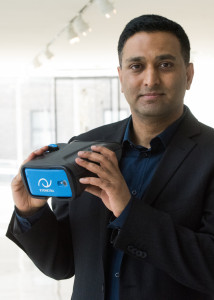
Ramesh Raskar, Associate Professor, MIT Media Lab

Ramesh Raskar joined the Media Lab from Mitsubishi Electric Research Laboratories in 2008 as head of the Lab’s Camera Culture research group. His research interests span the fields of computational photography, inverse problems in imaging and human-computer interaction.
Recent projects and inventions include transient imaging to look around a corner, a next generation CAT-Scan machine, imperceptible markers for motion capture (Prakash), long distance barcodes (Bokode), touch+hover 3D interaction displays (BiDi screen), low-cost eye care devices (Netra,Catra), new theoretical models to augment light fields (ALF) to represent wave phenomena and algebraic rank constraints for 3D displays(HR3D).

In 2004, Raskar received the TR100 Award from Technology Review, which recognizes top young innovators under the age of 35, and in 2003, the Global Indus Technovator Award, instituted at MIT to recognize the top 20 Indian technology innovators worldwide. In 2009, he was awarded a Sloan Research Fellowship. In 2010, he received the Darpa Young Faculty award. Other awards include Marr Prize honorable mention 2009, LAUNCH Health Innovation Award, presented by NASA, USAID, US State Dept and NIKE, 2010, Vodafone Wireless Innovation Project Award (first place), 2011. He holds over 40 US patents and has received four Mitsubishi Electric Invention Awards. He is currently co-authoring a book on Computational Photography. [Personal webpage http://raskar.info]


Scientists and Post-docs:

Douglas Lanman

Douglas is a Postdoctoral Associate at the MIT Media Lab. His research is focused on computational photography and displays, including light field capture, automultiscopic (glasses-free) 3D displays, and active illumination for 3D reconstruction. He received a B.S. in Applied Physics with Honors from Caltech in 2002 and M.S. and Ph.D. degrees in Electrical Engineering from Brown University in 2006 and 2010, respectively. Prior to joining MIT and Brown, he was an Assistant Research Staff Member at MIT Lincoln Laboratory from 2002 to 2005. Douglas has worked as an intern at Intel, Los Alamos National Laboratory, INRIA Rhône-Alpes, Mitsubishi Electric Research Laboratories (MERL), and the MIT Media Lab. He presented the "Build Your Own 3D Scanner" course at SIGGRAPH 2009 and SIGGRAPH Asia 2009 and the "Build Your Own 3D Display" course at SIGGRAPH 2010 and SIGGRAPH Asia 2010.

Gordon Wetzstein

Gordon's research interests include light field and high dynamic range displays, projector-camera systems, computational optics, computational photography, computer vision, computer graphics, compressive sensing, and augmented reality. He received a Diplom in Media System Science with Honors from the Bauhaus-University Weimar in 2006 and a Ph.D. in Computer Science at the University of British Columbia in 2011. His doctoral dissertation focuses on computational light modulation for image acquisition and display. He served on the program committee of IEEE ProCams 2007 and IEEE ISMAR 2010, won a Laval Virtual Award in 2005 for his work on projector-camera systems, and a best paper award for "Hand-Held Schlieren Photography with Light Field Probes" at ICCP 2011, introducing light field probes as computational displays for computer vision and fluid mechanics applications

Alex Olwal

Alex's research focuses on novel interaction techniques and technology, including augmented reality, handheld and spatial displays, medical user interfaces, spatially aware mobile devices, ubiquitous computing, as well as surface and touch-screen interaction. He received a M.Sc. and a Ph.D. in Computer Science and Engineering from KTH (Royal Institute of Technology), Stockholm and has worked as a visiting researcher at Columbia University (NY) and UC Santa Barbara (CA).

Christopher Barsi

Christopher is a Postdoctoral Associate in the Camera Culture group at the MIT Media Lab. He earned his Ph.D. in electrical engineering from Princeton University for his work integrating nonlinear wave physics with optical imaging. A key research interest is exploiting the properties of nonlinear propagation, which couples the different spatial and spectral components of a signal, for use in computational optics. Currently, he explores ultrafast optics and advanced numerical algorithms for development of novel tools in imaging and sensing.

Daryl Lim (Visiting Researcher)

Prior to taking up the M+Visión fellowship, Daryl Lim was a post-doctoral researcher in the Biomicroscopy Lab in Boston University. Born in Singapore, Daryl received his BS in Physics from the University of Leipzig and his PhD in Biomedical Engineering from Boston University. His research has focused on the conception and development of novel optical microscopy techniques. The techniques are often based on unconventional strategies (such as the harnessing of noisy processes) to improve a variety of optical setups including multi-photon, phase contrast, and optically sectioned microscopes. Applications of his work have led to advances in endomicroscopy and other in vivo modalities.


Graduate Students:

Andy Bardagjy

Andy is a second-year graduate student at the Camera Culture Group at the MIT Media Lab. He graduated from Georgia Tech in 2010 with a Bachelor of Science in Electrical Engineering. At Georgia Tech, he worked on ground, aerial, and underwater robots at the GTRI Robot Lab, the BORG Lab, and in RoboJackets. He worked on imaging and computer vision systems with Frank Dellaert and in the GTRI Electro-Optical Systems Lab. He recently was awarded the National Science Foundation Graduate Research Fellowship to support his work. He is interested in robotics, imaging, interaction and their overlap.

Matthew Hirsch (with Prof. Henry Holtzman)

Matt is a Ph.D. student at the MIT Media Lab. He works with Henry Holtzman's Information Ecology Group and Ramesh Raskar's Camera Culture Group. He graduated from Tufts University in 2004 with a Bachelor of Science in Computer Engineering. He worked from 2004 to 2007 at Analogic Corp. as an Imaging Engineer, where he designed threat detection algorithms for Computed Tomography security scanners. he is interested in all kinds of imaging devices, and using them to enable new understanding and interaction.

Otkrist Gupta

Otkrist Gupta is a MS student at MIT Media Lab. He works at camera culture, his research is focused on inventing new algorithms for hidden geometry detection, exploiting techniques from optimization , linear algebra and compressive sensing. He also works on designing algorithms for futuristic 3D projective displays. He completed his bachelors from Indian Institute of Technology Delhi (IITD) in Computer Science with emphasis on algorithms and linear algebra. Before joining MIT Media Lab, he worked for one year in field of High Frequency Trading at Tower Research Capital.

Nikhil Naik

Nikhil is a second year graduate student at the Media Lab. His research interests include computer vision/graphics and machine learning. At the Media Lab, he has worked on novel algorithms for material acquisition and scene analysis using ultrafast imaging. He has prior research experience in object tracking and biometrics. His hobbies are rowing and creative writing.

Aydın Arpa

Aydın was a Chief Architect of Nokia's Location & Commerce division (a.k.a. NAVTEQ) before joining to M.I.T. Media Lab. At Nokia, Aydın led teams that design and architect automatic map generation and visualization systems. He has more than 10 years of industry experience in computer graphics, computer vision, app development, and web technologies. Some of his work has been sold to Fortune 500 companies, while others have been featured in several top media outlets such as Wall Street Journal, BBC, The Times, Wired Magazine, and MIT Technology Review. He has more than a dozen domestic or international patents.

Kshitij Marwah

Kshitij Marwah is a first year graduate student at the MIT Media Lab. He did his undergraduate studies in Computer Science and Engineering from the Indian Institute of Technology, Delhi with his Master's thesis jointly at the Computer Science and Artificial Intelligence Laboratory at MIT and Harvard Medical School on efficient machine learning algorithms for inference over massive graphs. He was also a visiting student at Stanford University in his undergraduate where he worked on information theoretic ontology restructuring. He has interned at Google as a part of their initiative to create the next prodigy application and IBM on protocols for seamless financial transactions on mobile phones. His interests span efficient algorithms for large-scale computation, computational biology, ultra-fast imaging, computational photography, computer graphics and lately, the new paradigm of compressed sensing.

Jason Boggess

Jason Boggess is a research student at the Massachusetts Institute of Technology Media Lab, working as an Electrical Engineering and Computer Science student specializing in computer graphics and vision under advisor Ramesh Raskar. He started his Media Lab career working on the Bi-Directional display aiming to improve its special resolution and now working on advancements from the Eye NETRA and Eye CATRA health-care-on-a-cell-phone projects. Boggess received his undergraduate degree at Iowa State University in Ames, Iowa, in Mechanical Engineering, minors in Computer Science and Mathematics. In addition to graduating Summa cum Laude and as a full Honors Student, he served as President of the Inter-Residence Hall Association student-a fifty-member organization working closely with the ISU Department of Residence to create policy for over 6,000 undergraduate students. In his senior year, Jason won one of the few National Science Foundation Graduate Fellowships awards awarded to students at Iowa State University.


Undergraduate Students:

Henna Nandwani

Henna (Rachna) is a second-year undergraduate student at MIT. She is interested in researching new technologies of computational photography and medical imaging. Her experience includes electron tomography of the HIV/SIV entry protein.

Amy Fritz


Visitors:

Belen Masia from the University of Zaragoza, Spain

Belen Masia received her MS degree in Computer Science and Systems Engineering from Universidad de Zaragoza, Spain, where she is now enrolled as a PhD student. Currently she is a visiting student at the Camera Culture Group, MIT Media Lab. Her research interests lie in the fields of computational photography and applied perception. In particular (but not restricted to): coded apertures, computational displays, scene understanding and (simple/low-cost) light source and material acquisition. Her work has already been published in several venues, including Transactions on Graphics.

Matthew O'Toole from the University of Toronto

Matt is a Ph.D. student at the University of Toronto. His research interests include computational photography and illumination, light transport simulation, microscopy, appearance modelling, acoustic imaging, and numerical analysis. He received a B.Sc. in Computer Science and Mathematics from the University of British Columbia in 2007, and a M.Sc. in Computer Science in 2009. He also worked as an intern at NVIDIA, EA, MDA, and SideFX.

Siddharth Khullar from Rochester Institute of Technology

Siddharth Khullar is a third year doctoral student at the Chester F. Carlson Center for Imaging Science at the Rochester Institute of Technology. He is interested in learning about new technologies to advance mobile medical imaging, especially tools to simplify the experience of seeing and cognition. His most recent research is related to eye-tracking and its utility to provide real-time solutions to vision-related problems. His primary area of research is computational imaging, computer vision, and biosensor-based signal processing.

Kenishiro Fukushi from Tokyo Institute of Technology

Kenichiro Fukushi is a Ph.D. canditate at Tokyo Institute of Technology in Japan, and a visiting student at Camera Culture Group, MIT Media Lab. His background includes computer science and electronic engineering. He is interested in computer vision, computational photography, optical computing and human-computer interaction.

Di Wu from Tsinghua University

Di Wu is a Ph.D. student from Broadband Network & Digital Multimedia Lab, Department of Automation, Tsinghua University, Beijing, China. She is now a visiting student in Camera Culture Group. Her research interest is computational photography. Her most recent research is about femto photography. Her past works include camera array manipulation for high-speed 3D capture as well as temporal decomposition problem which aims to enable 3D motion deblurring algorithms. Her hobbies are table tennis, badminton, photography, traveling, etc.

Chinmaya Joshi from College of Engineering, Pune

Chinmaya is a junior undergraduate student in the Metallurgy and Material Sciences Department at the College of Engineering, Pune in India. He is a visiting student in the Camera Culture Group at the Media Labs. His current research at the media lab includes Femto-Photography and Quantum-Dot LED displays. In India, he is collaborated with the Polymer Sciences group at the Centre for Materials for Electronics and Technology. At CMET, his research has been on Dye-Degradation Polymer Substrates. His hobbies are hiking and creative writing.


Alumni:

Scientists and Post-docs:

Andreas Velten, 2012

Yun Hee Kim, 2011

Ankit Mohan, 2010

Daniel Saakes, 2010

Graduate Students:

Roarke Horstmeyer, 2011

Rohit Pandharkar, 2011

Kevin Chiu, M.S. 2011

Jaewon Kim, M.S. 2010

Ahmed Kirmani, M.S. 2010

Sharmeen Browarek, MEng 2010

Dennis Miaw, MEng 2010

Jordan Sorensen, MEng 2010

Undergraduate Students:

Tyler Hutchison, 2010

Ishaan Chugh, 2010

Biyeun M. Buczyk, 2010

Xiaoxi Wang, 2010

Visitors:

Vitor F. Pamplona, 2011

Abhijit Bendale, 2011

Erick Baptista Passos, 2011

Behzad Sajadi, 2011

Gordon Wetzstein, 2010

Tom Cuypers, 2010

Yasuhiro Mukaigawa, 2010

Manuel M. Oliveira, 2010

Masaki Suzuki, 2010

Gabriel Taubin, 2010

Shinsaku Hiura, 2009

Matthias Hullin, 2009

Grace Woo, 2008

Emily Zhao, 2008